Valorant's competitive ranking system uses RR (Rank Rating) points to place players across 9 tiers from Iron to Radiant. Understanding how RR gains, MMR mechanics, and rank distribution work helps players set realistic climbing goals and avoid frustrating rank stagnation. This comprehensive guide breaks down every rank tier, explains the ranking algorithm, and provides actionable tips to reach your target rank efficiently in 2026.
Valorant Rank Tiers and Distribution
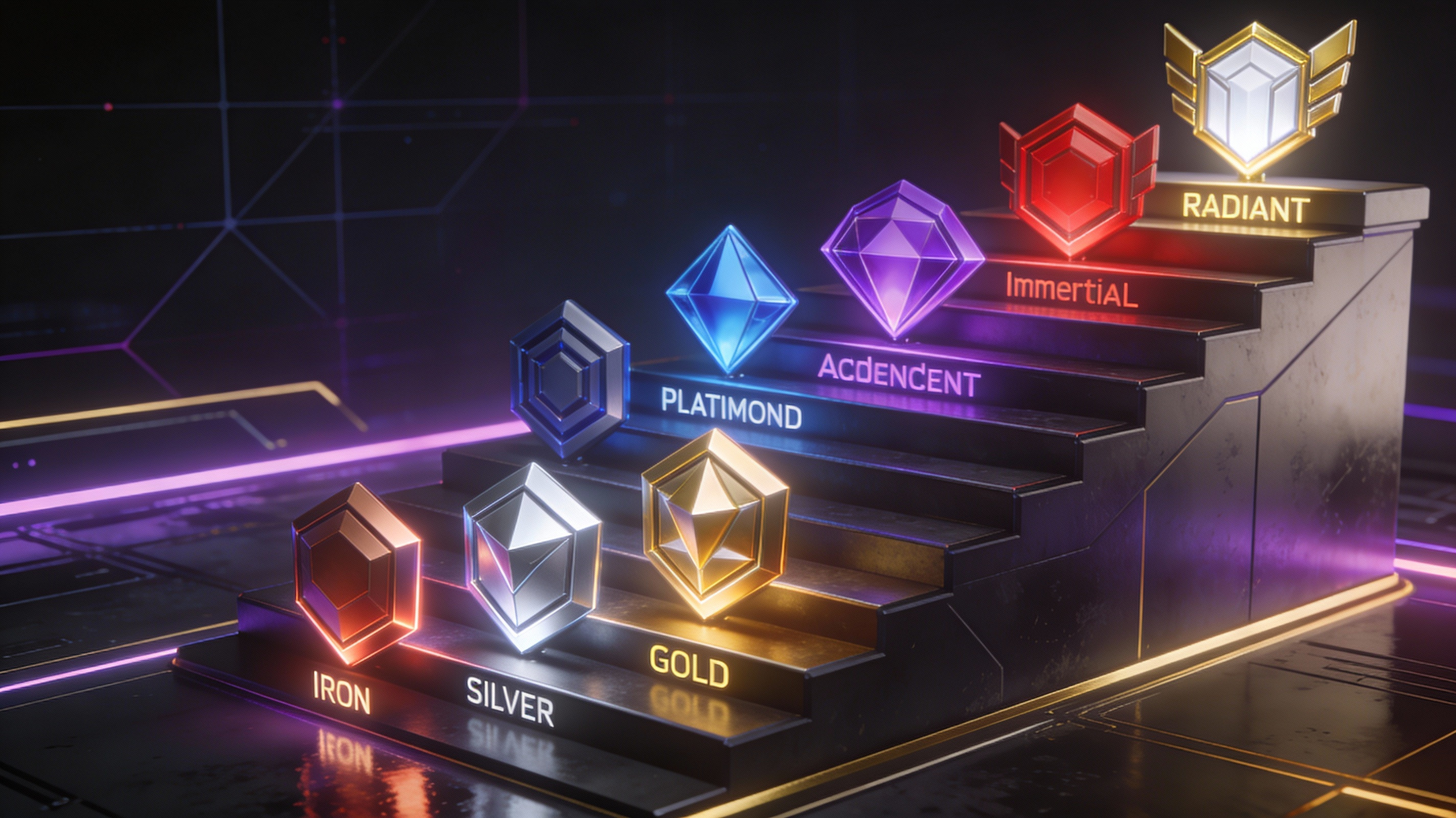
Valorant features 9 competitive tiers, each containing 3 ranks (except Radiant, which is a single tier). Players climb by earning 100 RR (Rank Rating) to advance one rank. The complete ranking structure from lowest to highest:
- Iron 1, 2, 3 - Entry rank for new competitive players (Bottom 15% of playerbase)
- Bronze 1, 2, 3 - Learning fundamentals (15-25% percentile)
- Silver 1, 2, 3 - Developing game sense (25-40% percentile)
- Gold 1, 2, 3 - Average skilled players (40-60% percentile)
- Platinum 1, 2, 3 - Above average mechanics (60-75% percentile)
- Diamond 1, 2, 3 - Strong fundamentals (75-90% percentile)
- Ascendant 1, 2, 3 - Near-elite gameplay (90-97% percentile)
- Immortal 1, 2, 3 - Elite players (97-99.5% percentile)
- Radiant - Top 500 players per region (Top 0.03%)
According to Riot's Episode 8 statistics, the average Valorant player sits around Gold 2, with only 1.5% of players reaching Immortal or higher. Radiant is incredibly exclusive, capped at the top 500 players in each region who maintain exceptional MMR ratings.
💡 Pro Tip
Your visible rank badge lags behind your true skill (MMR). Consistent performance across 20+ matches stabilizes RR gains and accurately reflects your skill level.
How RR (Rank Rating) Works
RR is the visible numerical system determining your rank progression. Every competitive match awards or deducts RR based on match outcome and individual performance:
Winning matches: Typically grants +10 to +30 RR depending on your performance and the rank difference between teams. Dominant wins with high combat scores award closer to 25-30 RR, while narrow victories give 15-20 RR. If you're heavily favored to win (your team's average rank is higher), expect lower RR gains around 10-15 RR.
Losing matches: Deducts -0 to -30 RR based on performance. Close losses where you performed well might only cost 5-10 RR, especially if your MMR is higher than visible rank. Getting demolished results in -20 to -30 RR losses. Players with positive win rates and strong performance can sometimes lose 0 RR on defeats due to performance-based protection.
Performance factors: Combat Score (calculated from kills, deaths, assists, first bloods, multi-kills, and economy damage) significantly impacts RR changes. Match MVP typically gains 3-5 bonus RR, while bottom fraggers lose 3-5 extra RR. However, performance impact decreases dramatically above Diamond rank where wins/losses matter more than individual stats.
MMR vs Visible Rank: The Hidden System
MMR (Matchmaking Rating) is Riot's hidden skill measurement that determines your actual matchmaking lobbies. Your visible rank (the badge displayed) often lags behind or exceeds your true MMR, creating RR gain discrepancies:
| Scenario | RR Per Win | RR Per Loss | What It Means |
|---|---|---|---|
| Rank > MMR | +10-15 | -25-30 | System lowering your rank to match skill |
| MMR > Rank | +25-30 | -5-15 | System boosting your rank upward |
| Balanced | +18-22 | -18-22 | Rank accurately reflects skill |
Rank higher than MMR: If you're Platinum 3 but the system believes your skill is Platinum 1 level, you'll gain less RR per win (10-15 RR) and lose more per defeat (25-30 RR). This forces your visible rank to drop until it matches MMR. Happens after loss streaks or when carried by higher-ranked friends.
MMR higher than rank: If you're Platinum 1 but performing at Platinum 3 level, expect huge RR gains (25-30 RR wins) and minimal losses (5-15 RR defeats). The system rapidly pulls your visible rank upward. Common after win streaks or for smurfs climbing to their main rank.
Episode and Act Rank Resets
Valorant implements two types of competitive resets affecting your rank progression:
Episode resets (every 6 months): All players experience a soft reset, typically dropping 1-2 full ranks. Your hidden MMR gets partially reset toward the median, then 5 placement matches determine your new starting rank. These matches have increased RR gains/losses (40-50 RR swings) making early Episode performance critical.
Act resets (every 2 months): Your visible rank becomes hidden, requiring 1 placement match to reveal updated rank. Acts don't significantly reset MMR—you'll place near your previous rank unless significant skill changes occurred. Think of Acts as soft checkpoints within an Episode's larger competitive season.
Climbing Strategy for Each Rank Bracket
Iron to Silver: Master the Fundamentals
Focus exclusively on mechanical skills. Practice crosshair placement at head level, learn spray patterns for Vandal and Phantom in the Range, and improve movement through deathmatch. Avoid complex strategies or agent-specific tactics—simply outaim opponents. Play duelists like Reyna or Jett to maximize fragging potential and carry games through pure mechanical superiority.
Gold to Platinum: Develop Game Sense
Add strategic thinking to solid mechanics. Learn common angles on all maps, understand economy management (full buy, eco rounds, force buys), and coordinate with teammates using basic comms. Start maining 2-3 agents across different roles to fill team needs. Study map control concepts—knowing when to push, hold, or rotate determines Gold-Platinum outcomes more than aim.
Diamond to Ascendant: Refine Team Play
Emphasize utility usage and team coordination. Master your main agent's ability combos, learn set executes for every map site, and practice trade fragging. VOD review becomes essential—watch your deaths and identify positioning mistakes. Playing off teammates' util and understanding role responsibilities (entry fragger, support, lurker) separates Diamond from Ascendant players.
Immortal to Radiant: Perfect Every Detail
Compete at near-professional level. Study pro player VODs for advanced positioning, optimize crosshair placement for pixel-perfect pre-aims, and develop clutch mentality under pressure. At this level, minor mechanical adjustments (counter-strafing precision, spray transfer speed) and mental fortitude distinguish Immortals from Radiants. Consider finding a consistent 5-stack to eliminate solo queue randomness.
🎯 Valorant Sensitivity Converter
Convert your sensitivity from other games to Valorant for consistent aim
Try Converter ToolCommon Ranking Mistakes to Avoid
Playing on tilt: Losing 2-3 games in a row drastically increases mistake frequency. Take 30-minute breaks after 2 consecutive losses to reset mental state. Tilted players average 15-20% lower performance, turning winnable games into guaranteed defeats.
Agent inconsistency: Mastering one agent (200+ hours) yields better results than playing 10 agents mediocrely (20 hours each). Your main agent should have 60%+ win rate. Secondary and tertiary agents serve as backups when your main gets picked or doesn't fit team comp.
Ignoring economy: Forcing weapons on eco rounds gives enemies free gun upgrades. Follow team economy—if 3 teammates can't full buy, everyone should eco together. Coordinated eco rounds with light armor + sheriffs sometimes win, but solo forcing with a rifle while team saves guarantees loss.
Blaming teammates: You can only control your performance. Focus on personal mistakes—reviewing YOUR deaths improves YOUR gameplay. Blaming teammates wastes mental energy and creates toxicity lowering team morale. Mute toxic players immediately rather than engaging in arguments.
Frequently Asked Questions
How many wins does it take to rank up in Valorant?
On average, 4-5 consecutive wins advance one rank if your MMR matches your visible rank. With positive MMR (hidden skill higher than badge), 3 wins can promote you. Conversely, if MMR is below visible rank, expect 6-8 wins needed due to reduced RR gains per victory.
Does KDA affect rank gains?
Yes, but primarily below Diamond rank. Combat Score (kills, assists, first bloods, multi-kills) adjusts RR by ±5 points. However, winning consistently matters far more than personal stats. A 0.8 KDA player with 55% win rate climbs faster than 1.5 KDA player at 48% win rate.
Can I derank from Immortal to Diamond?
Yes. Losing multiple games at Immortal 1 with 0 RR drops you back to Ascendant 3. However, you can't derank between Acts—your rank only moves down through losses, never from time decay or Act resets alone.
What's the fastest way to climb ranks?
Consistent 55-60% win rate over 100+ games. Focus on improving one skill per week (e.g., Week 1 = crosshair placement, Week 2 = utility usage), play during peak hours for better teammates (6-11 PM), and review one death per match to eliminate repeated mistakes.
Conclusion
Understanding Valorant's ranking system empowers you to climb efficiently rather than grinding blindly. Focus on fixing MMR-rank mismatches through consistent performance, master one agent deeply, and avoid tilt-induced loss streaks. With proper knowledge and dedicated practice, climbing from your current rank to your goal is achievable within 2-3 competitive acts.
Remember: Rank doesn't define your worth as a player—it's simply a measurement tool. Focus on daily improvement, enjoy the competitive grind, and your dream rank will come naturally through sustained effort.